


Black Bear Relocated Out of Town
February 18, 2026
By:
Meredith Carroll
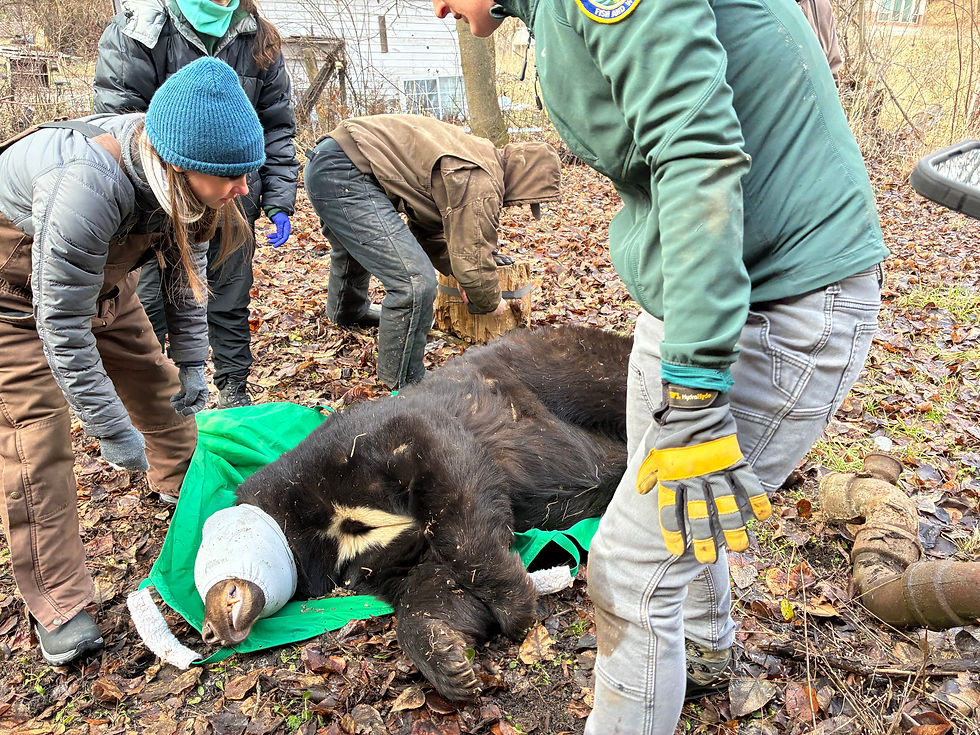
WDFW is in the process of moving the bear. Photo by Jared Keeling.
The Washington Department of Fish and Wildlife (WDFW) safely relocated a 7-8-year-old male black bear on Jan. 9; the bear had made a den beneath an abandoned structure in Hunters.
A Hunter’s resident noticed the bear in the neighborhood on Dec. 21, 2025. The large bear was caught on video and was not reacting to human movement or noise.
“The bear could have been coming out of hibernation, which would explain why it didn’t react,” said Jared Keeling with the WDFW. Keeling works in both private lands and as a conflict wildlife technician and was part of the team that relocated the bear.
“Normally, bears go into a light hibernation during the winter,” said Keeling. “Bears hibernate to conserve energy. It is completely normal for bears to get up, move around, and leave the den briefly. If a bear is moving around outside the den this time of year, that suggests there is a food source nearby. If a bear senses food nearby, they won’t go into hibernation.”
The Hunters resident, who wished to remain anonymous, saw an opening that led beneath the abandoned building that the bear appeared to have been using, and he called a report in to the WDFW. Keeling said he was dispatched to the site and confirmed that the bear had made a den beneath the property.
He said, “On Dec. 22, I entered the building, armed with bear spray, and visually confirmed the den site. Next, I called in the bear biologist who recommended that we should re-den the bear. The preferable choice was to trap the bear, but that ended up not working out.”
Keeling added, “The bear was trap-resistant, not interested in the bait we left. And we left some choice bait, too! In the end, though, the only one interested in the bait was a housecat.”
In the meantime, Keeling said he and his team were charged with finding a new, adequate den space for the bear.
“A bear’s den space is not a forever home,” said Keeling. “Bears use their dens as a temporary shelter, and then they make a decision whether they want to stay or go. It would have been preferable if we could find an abandoned den for relocating the bear.”
But, Keeling said, they couldn’t find one. So, the team made a lean-to for the bear and laid straw in preparation for the bear’s arrival. When the bear still had not expressed interest in the bait on Jan. 9, the WDFW team had to resort to option two: dart and re-den.
“We used a dart to render the bear unconscious. Then we pulled the bear through the 60” x 21” hole at the bottom of the building, put it in the trap, and drove more than 50 miles away to the new location. We wanted to move the bear far enough away so that it wouldn’t move back,” Keeling said.
Once the bear was safely transported to its new den, it was given a drug to wake up. The effect of the drug was pretty immediate, said Keeling, adding that soon after administration, there is a change in respiration and drooling. The bear experienced some disorientation at first and then spent some time in a recovery period. The recovery period and hibernation together may affect a bear’s metabolism.
“We put an ear tag on the bear for two reasons,” said Keeling. “First, it’s so we know if this same bear pops in in any future conflicts. Also, the chemicals that we use to knock the bear out are very harmful to people. If the bear is killed, legitimate hunters and poachers can call us with the ear tag information and find out if the bear has been given dangerous chemicals.
“Also, poached wildlife will be donated to the community.”
Bears emerging from their dens during the normal hibernation period are generally lethargic, disoriented, and in search of a meal, Keeling said.
“Seeing a bear in an urban location this time of year suggests a food source nearby,” he said. “If they seem less fearful, it might be because of that lethargy and disorientation. Bears might want to check out trash cans or chicken coops. If encountered at a trash can, they might think that they are treating us as fellow bears and swipe a paw, but that would be dangerous for humans.”
There are lots of attractants for bears in areas where the woods meet neighborhoods, such as fruit trees, livestock, and trash.
“If they find a food reward, they will continue returning to that food source,” said Keeling. “Anything with a scent can attract a bear. Livestock feed, including bird seed, oats, and corn. Think: anything that you might feed animals with.
“Feeding other animals from the porch. Don’t leave unsecured attractants. Lock up and put away food. Just think about the caloric density of the food we throw away, like pizza crusts, stale donuts, and the rest of a soft drink. Bears will even eat bones and baby diapers.”
Bears are more inclined to run away than pick a fight, according to Keeling. “If a person encounters a bear, get loud. Keep the bear in sight. A lot of times, it will run away. Is the bear not running away? Then get the bear spray out and use it as soon as it’s in range.”
Keeling continued, “There are steps you can take to keep bears away from attractants. For example, electric netting. There are kits for sale that will go around an enclosed area like a trash enclosure, and will shock but not hurt the bear.
“Human encounters with bears will almost always result in extermination. There are usually steps we can take to deter bears that do not involve lethal action. Call us and ask for advice. We will give advice to help come up with non-lethal solutions. Call us if you see an aggressive bear or one that exhibits concerning behaviors.” He added that “there will never be a negative consequence for the animal if you call with a concern. We always prefer to seek non-lethal methods, and there are many such methods that work, that are life-saving, that avoid conflict.”
The WFDW works with residents to set up netting, advise on the use of bear spray, and establish other non-lethal methods of deterring bears.
“I love bears, and I want to work with people on setting up bear deterrent practices,” said Keeling. “We’ve had 30 calls in the last year regarding bear concerns. Remember that it is not uncommon for bears to just pass through an urban area that is abutted by wilderness. We work hard to avoid killing bears, but we also try to avoid relocating them, too. Relocation is hard for the bear to adapt to the new location.
For more information, call WDFW’s direct line for enforcement at 877-933-9847.