


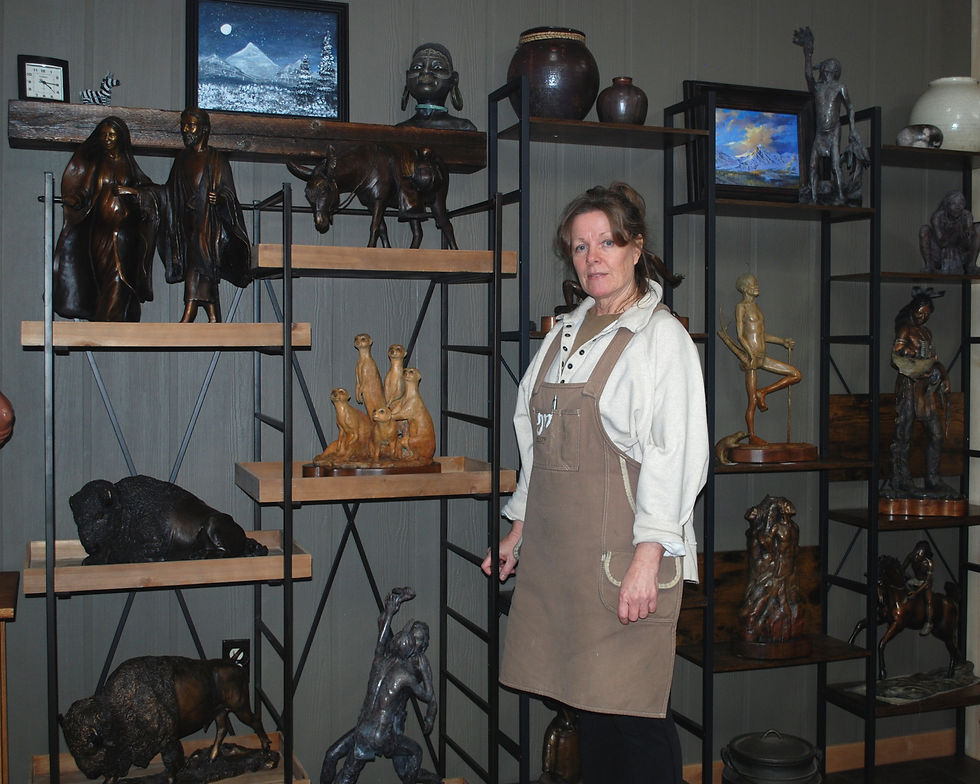
Made Here; Three-Dimensional Artist Sonja Metzler
January 28, 2026
By:
Wayne Gorst
Sonja Metzler’s studio and three-dimensional art. Photo courtesy Wayne Gorst.
This recurring feature highlights the artists, makers and creative spaces that help define our community. Each installment spotlights local talent, and readers are encouraged to submit nominations for artists or arts organizations to be featured to editor@statesmanexaminer.com or to Statesman-Examiner, 220 S. Main St., Colville, WA 99114.
Sonja Metzler wasn’t always a sculptor, but she’s always been an artist.
A Colville area resident since 1998, Metzler said her artistic journey began with art school in her childhood home of Johannesburg, South Africa. Following a stint in commercial art on South Africa’s east coast, she took up engineering drafting, which brought her to the Inland Northwest via Anchorage, Alaska, and Bellingham, Wash., eventually settling near Colville with her husband and their horses.
Discussing why she was drawn to sculpture, Metzler said, “I always seemed to gravitate more toward a ball of clay than a pencil. Although I casually enjoy several mediums, I love the space taken up by three-dimensional art. I love that I can create my art from every angle; and clay serves that purpose well.”
With a nudge from another local sculptor, Jerry McKellar, Metzler began showing – and selling – her work at the Safari Club International (SCI) show in Las Vegas. Other major shows ensued, and the Metzlers soon found themselves rubbing elbows with major artists at shows from San Diego to Nashville.
Closer to home, Metzler said her growing reputation led to a significant commission – Mary, Joseph, and their donkey on their sojourn to Bethlehem. Commissioned by a local Catholic church, the three bronze figures welcome visitors to the small courtyard near the entrance to the house of worship.
The piece was originally conceived as a life-sized statue, something Metzler said she had longed to apply her talents to, using the experience to expand her artistic skills and burgeoning catalog of work. However, the turmoil and restrictions brought on by COVID-19 extended the timeframe and reduced the scale of the project to a one-quarter size statue, known in the sculpting world as a “maquette,” according to Metzler.
Typically, sculptors, like painters, limit the number of copies, or in the case of a sculpture “editions,” of their work to retain and enhance the value of each piece, Metzler said. She added that the agreement with the church allowed the artist to retain the rights to the molds, conferring the potential for several more editions of Mary, Joseph, and the donkey.
Metzler said creating a bronze sculpture is not just an artistic endeavor, although that’s where it all begins. There are numerous steps, processes, and people between the original ball of clay and the final, weighty bronze. It all begins with an idea and a ball of oil-based clay, Metzler explained. Depending on how large or complex the finished piece will be, the artist may start with a flexible metal armature that will provide support and stability for a heavy or complex clay figure built upon it. When the clay is meticulously shaped and formed with every fine detail crafted into place, the clay rendition becomes the master. From there, Metzler said, the piece goes to a bronze casting foundry; she said she works with one of the two in Joseph, Ore. Foundry technicians then carefully create a flexible rubber mold over the clay, brushing on multiple, thin layers until they’ve built up a flexible rubber skin that captures every detail, as created by the clay master. Metzler said a rigid outer shell of fiberglass or plaster is then added to hold the rubber in the exact shape of the original and protect the mold. Removing the mold from the clay, the mold is then filled with wax to create a perfect replica of the original. According to Metzler, the new wax original is then used to create yet another mold capable of withstanding the final molten bronze pour. The last step before that final “negative” mold is ready is the lost wax casting process, whereby the mold is heated to around 1,400 degrees Fahrenheit to melt out all the wax and ready the mold for the final molten bronze pour.
Often, the original clay piece must be cut into smaller, castable sizes and subsequently put back together in the final bronze, Metzler said, requiring meticulous effort by skilled technicians and artisans at the foundry. When the piece is once again whole and declared ready by both the artist and the technicians, it moves on to the patina stage where another dedicated artist uses just the right amount of heat, combined with the proper chemicals, to bring about the various shades of luster that define the perfect bronze.
It was the Nashville SCI show where Metzler said she got her wish; she was commissioned to complete a life-size sculpture of Jerry Lee Lewis playing on his baby grand piano. She said a private corporation had begun a real estate development project in the town of Southaven, Miss., just south of Memphis, Tenn., near the life-long home of Lewis whom they wanted to honor with a life-size bronze. Brian Hill, the corporate CEO, told Metzler, after looking over the work of numerous bronze sculptors, that he liked her style the best and asked if she would be interested in the project. “You had me at life-sized,” she had replied, “and then when I heard it was Jerry Lee Lewis, I was completely captivated.”
The project occupied nearly a year-and-a-half of planning, researching, sculpting, and, eventually, installing the finished bronze, complete with an unveiling with JLewis’ widow, Judith Lewis, in attendance, Metzler said.
During the research phase of the project, Metzler said she asked Judith Lewis if there was anything specific she would like included. In reply she got pictures of two rings Jerry Lee Lewis wore: one was a diamond studded baby grand piano and the other was the wedding ring Judith Lewis had given him.
In all her pieces, just as she did with Lewis’ rings, Metzler said she does extensive research to ensure every detail is included and correct. Her work includes a commission for an accurate representation of an 1880s style bison hunt. Three hunters, their wagon, camp, guns, and all accoutrements are authentically reproduced at scale. A small group of bison graze warily in the distance. When the clay rendition has been perfected and they return from the foundry, their pastures and hunting grounds will be at the top of a conference table somewhere in Arizona, Metzler said.
More information can be found at sonjametzler.com.