


Rep. Engell Raises Eastern Washington Concerns with Gov. Ferguson
November 19, 2025
By:
Cami Krema
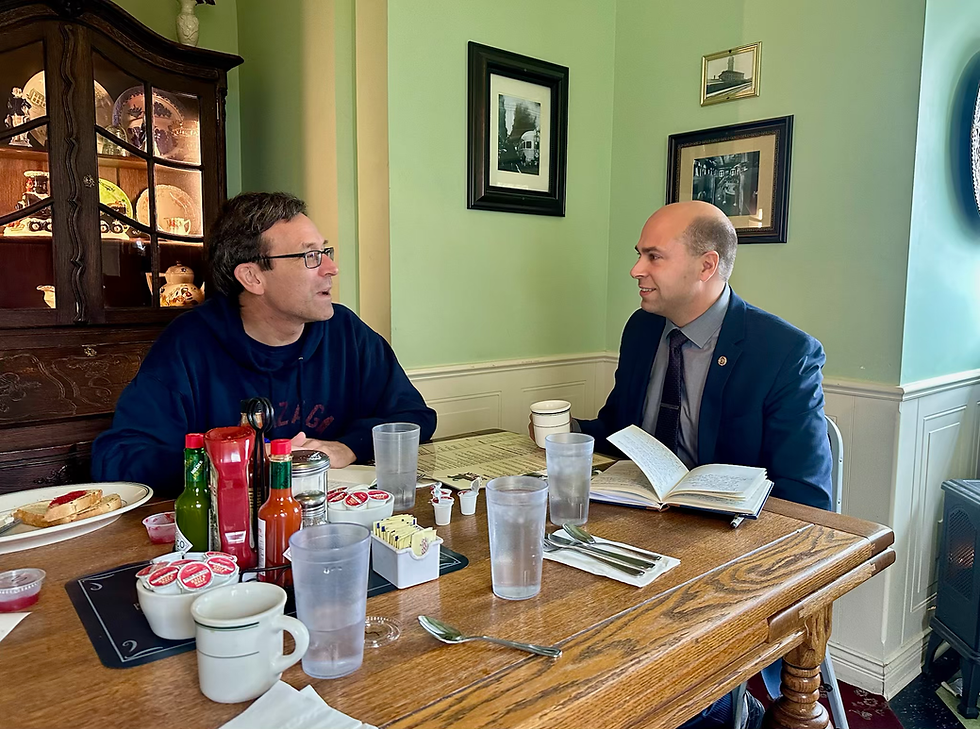
Gov. Bob Ferguson (left) and Rep. Andrew Engell (right) discuss issues surrounding the state at the Knight's Diner in Spokane. Photo courtesy Andrew Engell.
Representative Andrew Engell (R-Colville), met with Washington state governor Bob Ferguson in Spokane on Nov. 8, to discuss local issues and explore common ground. Engell said that his goal for the meeting was to help build trust in the state government, reduce tension between the urban and rural communities, and ensure the east side of the state is heard.
Engell discussed the issues he brought to Ferguson, which included:
Food Safety Modernization Act regulations and how they affect rural farming
Wolf management in Stevens and Ferry counties
How the Growth Management Act affects rural communities
The relationship between the Department of Ecology and farmers
Childcare center closures due to new teacher regulations
COVID-19 vaccine mandates
The need for more sustainable transportation
Columbia River salmon and sturgeon mandatory endorsements
Gender inclusivity policies in schools
The banning of septic system types
Attacks on hydropower
L&I and local business
The potential closure of NEW Family Life Services’ Crisis Pregnancy Center
Engell said that while they weren’t able to review each point in depth, he was able to summarize them for the governor. “Those points were preparation for me, and were something I could give him [to review],” Engell said, adding that he started the conversation by telling Ferguson, “A lot of people here feel pretty beat down and like they're just losing. It creates a lot of this tension.
I want to try to make this better.” Engell said that Ferguson seemed to agree, adding, “So I gave him these specific examples of some things that I felt should be bipartisan.”
Engell continued, “I ran on the concept that I was still conservative, but I believe in treating everybody with respect and well,” and said that he and Ferguson found common ground in their shared faith. “That means that we're supposed to treat everyone as people created in the image of God, in which [Ferguson] agreed with.”
Engell said that, after he gave his talking points to Ferguson, one of the first issues they addressed was the crisis pregnancy center. He said he heard from those working at the center that Ferguson was trying to shut them down, which piqued the governor’s concern. “Ferguson was quickly like, ‘Tell me more about this,’ and [I told him] I don't know that that's true at all. All I know is that [the crisis pregnancy center] said it to a group of 300 people. That's indicative of our challenge of a low trust environment. Maybe it's a rumor, who knows where it came from? But [the center is] concerned enough they made an issue out of it and told a bunch of people.” Engell said he told Ferguson, “You can count on me to be truthful whenever I can. Everybody makes mistakes, but I have a commitment to truth. And if we can have an open door policy, I'd like to be able to ask you about these things when I hear about them and I'll commit to not spreading false information and helping to focus on correcting these misquotes.”
He added that Ferguson, “seemed to appreciate that,” and indicated he was looking into all of the crisis pregnancy centers in the state, adding that he would also look into what might be making the centers feel that way.
Engell said another point the two spoke about in depth were federal regulations that potentially harm rural farmers. “My farm was put out of business by federal regulations,” Engell said and discussed how he was a certified organic vegetable farmer who sold garlic online. “[The regulations] were not really designed for tiny little farms like mine. I'm just like, ‘I can't figure out how to do this.’ In hindsight, now I'm really a lot better at jumping through hoops and I probably could have figured it out. But when you're barely surviving, any extra regulatory weight at all can be the last straw.”
Another issue Engell discussed was the Department of Ecology’s regulations surrounding farmers and potential pollution. “You don't have to be proven [to be] actually causing any pollution,” he said, adding that the department could see cows near water and determine there is an “opportunity to pollute.” Engell said, “That’s considered a crime now in Washington.” He continued that it’s hard to convince farmers to alter their methods because they’ve “been doing this for generations. And all of a sudden now they're deemed a polluter without any kind of proof.” Engell added that Ferguson “seemed to be sympathetic,” and agreed they had to be more careful with regulations like that. “The point is, you have people and organizations and groups that feel like ‘the state is coming after me. They're trying to put me out of business. They're trying to kick me out of the region,’” he said.
Engell also said that farmers are a minority group in the state. “The minority people live in rural areas. The majority of people live in these other areas and they have a different frame of reference when they're [creating] these regulations, and [farmers] are not involved in the decisions.” He said that when new regulations come out that affect farmers, many of them feel confused and frustrated. “Sometimes there might be a public benefit and it might be great, but if we aren't explaining it well enough to those people, if they just feel like they’re being beat for no reason, even if there is a reason, that's a problem in and of itself. It undermines trust in government,” Engell said.
He continued that, along with rebuilding trust between people and the government, the two also discussed problems with bi-partisanship and sensationalism. “We need to get to the facts, and argue over real problems,” Engell said.
Food security was another issue that Engell addressed with the governor, saying they both had concerns about people not getting their Supplemental Nutrition Assistance Program benefits. Engell said, “[Ferguson asked] ‘how can we help here?’ I told him I thought helping the food banks is a good way because it's a cheaper way to help the people who need to help the most. He did find $2 million last week to give to the food banks.”
Engell also said that Ferguson asked him if he would consider accompanying him to Washington D.C. to meet with Dr. Oz and advocate for Washington’s health care. Engell did not have additional details about the invitation but called it “an interesting opportunity,” and added “if [the governor and I] could be unified on the fact that we both want to preserve access to healthcare for patients in Washington, I'd see that as a positive.”
Engell said he used his meeting with the governor to talk about his policies that he feels could benefit the 7th district including: a warranty for license plates if the paint chips off within a certain period of purchase; allowing physician assistants to perform certain procedures when a physician is not on site; making it easier to harvest trees along power lines and around houses without having to get a permit; bringing in nursing programs that would be easier to access to address the state’s nursing shortage; and adjusting gravel pit fees.
“We want to be engaging with the people in charge. In this case, it's the Democrats,” Engell said. “There's no question that [Ferguson and I are] on different sides of the political aisle, but I hope we share the interest in making a government that works better for people. [Ferguson] says he wants to be the governor for all of Washington. I'm like, ‘I want to help you do that.’”
Engell added that “really, the focus is, we have to figure out how to bring down this political rhetoric. The polarization is way too bad, it's messy. Most people are tired of it. I mean, so many people have family and friends that no longer speak to them anymore because of this. This is not how it’s supposed to work. [Ferguson] seemed to be in agreement, that he wants to bring this down. He wants to be the governor for all of Washington.”
Reflecting on the experience overall, Engell said, “I appreciated the opportunity to meet with [the governor]. I'm not joining him; but at the same time, I don't want to disrespect him either.”